Planning a peaceful visit to the famous Balkampet Yellamma Temple can feel confusing when you are unable to find the correct darshan hours, pooja schedule, or crowd timings online. Many devotees search again and again just to get accurate Balkampet Yellamma Temple Timings before starting their journey. Whether you are visiting for blessings, a special pooja, or your first temple trip in 2026, knowing the right Balkampet Yellamma Temple Timings can make your visit calmer and more meaningful.
This complete 2026 guide is created to help you find updated Balkampet Yellamma Temple Timings, darshan details, aarti schedule, pooja information, and the best time to visit without confusion. You will also learn useful travel tips, important temple rituals, and how to plan your visit smoothly with your family. If you were searching for clear and trustworthy information about Balkampet Yellamma Temple Timings, this blog will give you everything in one simple place.
The Essence of Goddess Yellamma Devi
Goddess Yellamma Devi is deeply respected by devotees across South India. People worship her as a strong and caring form of Goddess Shakti. Many believe her blessings bring courage, protection, and emotional comfort during difficult times. Her temples in Telangana and Karnataka attract devotees who come with faith and prayers for peace.
For many followers, Goddess Yellamma Devi represents devotion, hope, and spiritual strength. Her stories come from ancient traditions and local beliefs that have been followed for generations. Devotees see her as a divine mother who listens to sincere prayers and supports her followers in times of need.
- Goddess Yellamma Devi is worshipped as a form of divine Shakti.
- Her worship is very popular in South India.
- Devotees believe she offers protection and healing.
- She is respected as a loving and caring mother goddess.
- Her traditions are connected with old folklore and beliefs.
- Many temples dedicated to her receive large numbers of devotees.
- She represents devotion, faith, and spiritual power.
A Spiritual Beacon in Hyderabad
The Balkampet Yellamma Temple is one of the most respected spiritual places in Hyderabad. Thousands of devotees visit the temple to pray for blessings, peace, and strength. The temple is known for its strong spiritual atmosphere and deep devotion to Goddess Yellamma Devi.
A Place of Faith and Healing
Balkampet Yellamma Temple is known as a place where people come with hope and prayers. Many devotees believe the goddess helps them find relief from problems and brings emotional peace. The calm surroundings and spiritual energy make the temple an important center of faith.
The Spiritual Magnet of Hyderabad
Balkampet Yellamma Temple attracts devotees from Hyderabad and nearby regions every day. People visit to seek blessings, guidance, and inner peace. The temple is famous for its spiritual importance and the strong faith shared by its visitors.
History and Legends of Balkampet Yellamma Temple
The history of Balkampet Yellamma Temple is closely connected with devotion to Goddess Yellamma Devi. People believe the temple has existed for many years and has become an important place of worship in Hyderabad. Its stories and traditions continue to inspire generations of devotees.
According to local beliefs, the temple is linked with several miracles and divine blessings. Devotees believe Goddess Yellamma helps remove hardships and fulfills sincere prayers. Over time, the temple became a well-known pilgrimage destination for people seeking peace and spiritual comfort.
The Legend of Goddess Yellamma (Renuka Devi)
The story of Goddess Yellamma, also known as Renuka Devi, is connected with sacrifice, devotion, and strength. She is associated with Lord Parashurama in Hindu traditions. Devotees believe her blessings bring courage, faith, and spiritual guidance.
How the Temple Originated in Balkampet
The Balkampet temple is believed to have started as a small shrine dedicated to Goddess Yellamma Devi. With growing devotion and faith among local people, it gradually developed into a major spiritual center in Hyderabad.
Connection to Other Yellamma Temples in South India
Goddess Yellamma Devi is worshipped in many parts of South India. Each temple follows its own customs and rituals, but all are connected through shared faith and devotion. Balkampet Yellamma Temple is considered an important part of this spiritual tradition.
| Temple Location | State | Significance |
| Saundatti | Karnataka | Known as the most sacred Yellamma Peetham |
| Badami | Karnataka | Famous for ancient cave worship traditions |
| Yellampally | Andhra Pradesh | Known for Renuka Devi rituals |
| Basavakalyan | Karnataka | Important center for Shakti worship |
| Balkampet | Telangana | Popular urban pilgrimage temple |
| Kolhapur Mahalakshmi link shrines | Maharashtra | Spiritually connected through Shakti traditions |
Historical Importance in Hyderabad’s Culture
Balkampet Yellamma Temple holds a special place in Hyderabad’s cultural and spiritual history. The temple has helped preserve traditions, devotion, and unity among devotees for generations. It continues to remain an important symbol of Hyderabad’s spiritual heritage.
Spiritual Belief and Legacy
The spiritual legacy of Balkampet Yellamma Temple is built on strong faith in Goddess Yellamma Devi. Devotees believe she blesses people with peace, healing, and protection. This devotion continues to inspire families and strengthen spiritual belief across generations.
Deity and Spiritual Significance of Balkampet Yellamma Temple
The spiritual importance of Balkampet Yellamma Temple is centered around Goddess Yellamma Devi, worshipped as a powerful form of Shakti. Devotees believe she protects them during difficult times and gives strength to overcome struggles. The temple remains a sacred place where people come to pray with faith and devotion.
The temple also reflects Hyderabad’s spiritual and cultural traditions. Visitors seek blessings for health, peace, and happiness in their families. Daily rituals and prayers create a strong spiritual connection between the goddess and her devotees.
Who is Goddess Yellamma?
Goddess Yellamma is worshipped across South India as a respected form of Goddess Shakti. She is also known as Renuka Devi. Devotees believe she protects people from harm and guides them through challenges with motherly care and compassion.
- Goddess Yellamma is a form of Goddess Shakti.
- She is also called Renuka Devi.
- Devotees worship her for protection and courage.
- She is seen as a caring mother goddess.
- Her worship is popular in South India.
- Her stories are linked with ancient Hindu traditions.
- Devotees believe she answers sincere prayers.
The Idol of Goddess Yellamma at Balkampet
The idol of Goddess Yellamma at Balkampet Temple is highly respected by devotees. People believe the idol carries strong spiritual power and divine blessings. Devotees visit the temple daily to pray for peace, healing, and protection in their lives.
- The idol represents Goddess Yellamma Devi in sacred form.
- Devotees believe it has powerful spiritual energy.
- People pray here for blessings and safety.
- The idol is important in daily temple rituals.
- Thousands of devotees visit the temple regularly.
The Holy Water (Tirtham)
The holy water, known as Tirtham, is considered very sacred by devotees at the temple. People believe it contains the blessings of Goddess Yellamma Devi. Many devotees take this water after prayers with faith that it brings peace, healing, and protection.
- Tirtham is the sacred water given at the temple.
- Devotees believe it carries divine blessings.
- It is used for healing and spiritual comfort.
- The water is distributed after rituals and prayers.
- Many believe it removes negativity from life.
Symbolism of Yellamma Worship
The worship of Goddess Yellamma represents faith, strength, and devotion to divine power. Devotees see her as a symbol of protection, compassion, and emotional healing. Her worship encourages people to trust in spiritual guidance during difficult phases of life.
- Represents divine feminine energy and Shakti.
- Symbolizes faith, courage, and protection.
- Connected with healing and emotional peace.
- Encourages devotion and surrender to the goddess.
- Reflects the spiritual traditions of South India.
Temple Timings and Darshan Schedule of Balkampet Yellamma Temple
The Temple Timings and Darshan Schedule of Balkampet Yellamma Temple follow a regular daily routine for devotees visiting the shrine. The temple opens early in the morning with sacred rituals and remains open for darshan until afternoon before reopening in the evening. Many devotees visit throughout the day to pray and seek blessings from Goddess Yellamma Devi.
The Temple Timings and Darshan Schedule of Balkampet Yellamma Temple can change slightly during festivals and special occasions. Tuesdays and Fridays are usually the busiest days because of higher devotional importance. Many visitors prefer morning or evening hours to avoid long waiting lines and enjoy a peaceful spiritual atmosphere.
Daily Temple Timings
The Daily Temple Timings of Balkampet Yellamma Temple are arranged in a simple schedule for visitors and devotees. The temple begins daily worship early in the morning and closes after evening rituals. Planning your visit according to the timings can help make the darshan more comfortable and peaceful.
| Session | Opening Time | Closing Time |
| Morning Session | 5:00 AM | 12:30 PM |
| Evening Session | 4:00 PM | 8:00 PM |
Balkampet Yellamma Temple Tuesday Timings
Tuesdays are considered very important for worship at Balkampet Yellamma Temple. A large number of devotees visit the temple on this day to seek blessings from Goddess Yellamma Devi. Special rituals and prayers are organized, and darshan hours may continue longer because of the crowd.
- Tuesdays are considered highly sacred for Yellamma Devi worship.
- The temple opens early for special prayers and darshan.
- Large crowds are seen throughout the day.
- Devotees offer special poojas and prayers on Tuesdays.
- Darshan timings may be extended during busy hours.
- Morning visits are better to avoid long queues.
- Many devotees believe Tuesday prayers bring blessings and fulfillment.
Balkampet Yellamma Temple Sunday Timings
Sundays at Balkampet Yellamma Temple also attract many visitors because families often choose this day for temple visits. The temple usually follows the regular daily schedule, but morning and evening hours can become crowded. Many devotees prefer visiting early for a calm and peaceful darshan experience.
- Sundays follow the regular temple schedule.
- Morning hours are usually more peaceful.
- Evening hours often have a larger crowd.
- Families commonly visit the temple on Sundays.
- Early darshan is recommended for a better experience.
Morning Rituals (Suprabhata Seva and Alankarana)
The Morning Rituals (Suprabhata Seva and Alankarana) begin the day with prayers and devotion at the temple. During Suprabhata Seva, priests wake the goddess with sacred chants and hymns. Devotees believe these rituals create positive spiritual energy for the entire day.
- Suprabhata Seva is the early morning prayer ritual.
- Alankarana includes decorating the goddess with flowers and ornaments.
- Priests perform the rituals with devotion and chanting.
- Many devotees attend these morning ceremonies daily.
- People believe the rituals bring peace and blessings.
Daily Pooja Schedule
The Daily Pooja Schedule of Balkampet Yellamma Temple follows a fixed routine of rituals and worship throughout the day. Priests conduct every pooja with traditional prayers and devotion. Devotees attend these rituals to receive blessings and experience a calm spiritual environment according to the Balkampet Yellamma Temple Timings.
The Daily Pooja Schedule of Balkampet Yellamma Temple starts early in the morning and continues until night. Each ritual has a different purpose, including prayers, decoration of the deity, and aarti ceremonies. The schedule helps devotees plan their visit easily and attend important rituals without confusion.
| Time | Seva / Ritual | Purpose |
| 5:00 AM | Suprabhata Seva | Morning awakening prayers for the goddess |
| 6:00 AM | Abhishekam | Sacred bathing ritual using holy items |
| 7:00 AM – 9:00 AM | Alankarana and Archana | Decoration and flower offerings |
| 9:00 AM – 12:00 PM | General Darshan & Poojas | Devotees offer prayers and worship |
| 12:00 PM | Noon Aarti and Naivedyam | Midday aarti and food offering |
| 12:30 PM | Temple Break | Short temple closure for rest |
| 4:00 PM | Evening Darshan Opens | Temple reopens for devotees |
| 6:00 PM | Special Archana | Evening special prayers |
| 6:30 PM | Maha Mangala Aarti | Grand evening aarti ceremony |
| 8:00 PM | Temple Closing Rituals | Final prayers before closing |
Aarti Timings
Aarti Timings at Balkampet Yellamma Temple are important moments of daily worship. During these rituals, devotees gather to pray and experience the spiritual atmosphere of the temple. The aarti ceremonies create a strong sense of devotion and peace.
- Morning Aarti: 6:30 AM
- Noon Aarti: 12:00 PM
- Maha Mangala Aarti (Evening Aarti): 6:30 PM
Balkampet Yellamma Temple Timings During Navratri
During Navratri, the temple authorities extend the Balkampet Yellamma Temple timings because of the large number of devotees visiting for special celebrations and prayers dedicated to Goddess Yellamma Devi.
Key Points:
- The temple opens earlier during Navratri celebrations.
- Closing hours are extended because of the heavy crowd.
- Special poojas and festive rituals are organized daily.
- Morning and evening aartis attract many devotees.
- People offer flowers, coconuts, and prayers to the goddess.
- Continuous darshan arrangements are made for visitors.
- The temple remains spiritually vibrant during Navratri days.
Special Sevas and Booking Information
Special Sevas and Booking Information at Balkampet Yellamma Temple allow devotees to participate in important rituals in a smooth way. These sevas give visitors a more personal devotional experience. Advance booking through temple counters or official sources helps avoid delays and heavy rush.
| Seva Name | Purpose |
| Abhishekam Seva | Sacred bathing ritual of the goddess |
| Kumkumarchana Seva | Offering kumkum with prayers |
| Alankarana Seva | Decorating the goddess with flowers |
| Yellamma Kalyanam Seva | Divine marriage ceremony ritual |
| Annadanam Donation | Offering food service to devotees |
Best Time for Darshan
The best time for Darshan at Balkampet Yellamma Temple is usually during early morning or late evening hours when the crowd is smaller and the temple atmosphere feels more peaceful and spiritual.
- Early morning is ideal for peaceful darshan.
- Weekdays are usually less crowded than weekends.
- Tuesday and Friday mornings are considered highly auspicious.
- Evening aarti time gives a strong devotional experience.
Major Festivals Celebrated at Balkampet Yellamma Temple
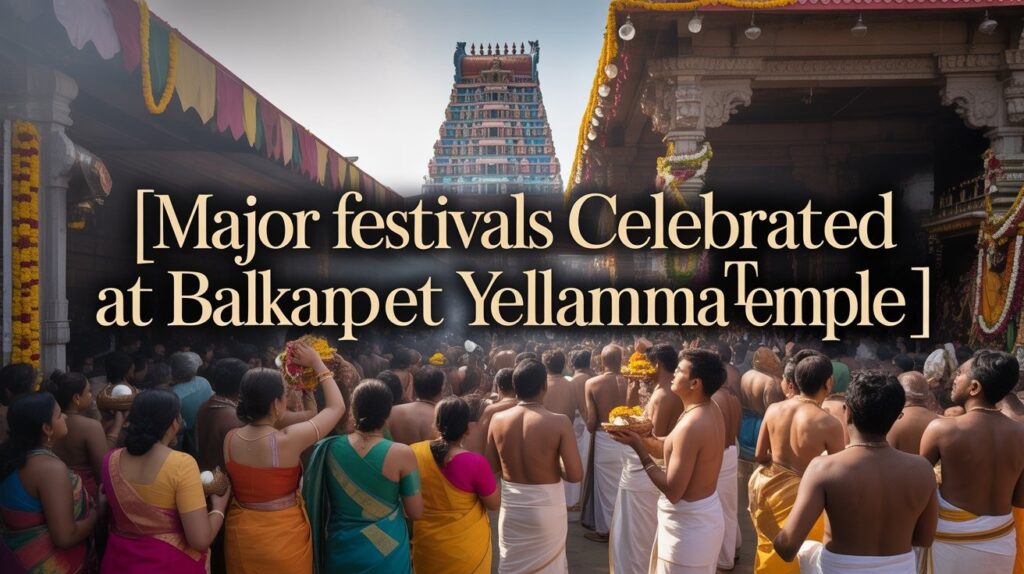
People who think temples remain calm throughout the year are often surprised after visiting Balkampet Yellamma Temple during festival time. As soon as celebrations begin, the temple becomes full of lights, devotional songs, prayers, and colorful decorations. The atmosphere changes completely, making every visit feel special and spiritually uplifting around Balkampet Yellamma Temple Timings.
The major festivals celebrated at the temple are more than just religious occasions. Families, local devotees, and visitors from different places gather together with devotion and excitement. The sounds of drums, chants, and temple bells create a powerful spiritual feeling that leaves a lasting memory for everyone who attends.
Yellamma Kalyanam – The Divine Wedding Celebration
Yellamma Kalyanam is one of the most important rituals celebrated at the temple. This sacred event represents the divine marriage ceremony of Goddess Yellamma Devi. Devotees participate to pray for happiness, family harmony, and blessings in their lives while experiencing a deeply spiritual atmosphere.
Bonalu Festival – The Spirit of Telangana Devotion
The Bonalu festival fills the temple with devotion, music, and traditional celebrations. Women carry decorated pots as offerings while devotional songs and drum beats continue throughout the event. Devotees express gratitude to the goddess, making the festival emotional and spiritually powerful.
Navaratri Celebrations – Nine Nights of Divine Energy
Navaratri celebrations at the temple continue for nine sacred days dedicated to Goddess Shakti. Special poojas, aartis, and rituals are performed every day. The temple becomes vibrant with lights, prayers, and devotional energy as large crowds gather for blessings.
Shankranti and Ugadi – Seasonal Devotion and Fresh Beginnings
Shankranti and Ugadi are celebrated with peace and devotion at the temple. Devotees offer flowers, prayers, and gratitude while seeking blessings for a positive new beginning. Compared to larger festivals, these occasions usually have a calmer and more peaceful atmosphere.
Pournami (Full Moon Day) Abhishekams – Lunar Devotion Rituals
Full moon days hold special importance at Balkampet Yellamma Temple. During Pournami Abhishekams, priests perform sacred rituals using holy water, milk, and prayers. Many devotees visit during these nights to experience spiritual calmness and positive energy.
Poojas, Sevas, and Rituals at Balkampet Yellamma Temple
The temple follows a regular daily ritual schedule with prayers and sevas performed throughout the day for devotees.
- Suprabhata Seva (5:00 AM): Morning ritual to awaken the goddess with sacred chants.
- Abhishekam (6:00 AM to 7:30 AM): Holy bathing ritual performed for spiritual purification.
- Alankarana Seva (8:00 AM): Decoration of the deity with flowers, ornaments, and silk clothes.
- Kumkumarchana (9:00 AM to 12:00 PM): Special kumkum offering while reciting the names of Goddess Yellamma.
- Naivedyam and Maha Mangala Aarti (12:00 PM): Offering food to the goddess followed by midday aarti.
- Evening Maha Aarti (6:30 PM): Evening lamp ritual performed with devotion before the deity.
Route Map and How to Reach Balkampet Yellamma Temple
Reaching Balkampet Yellamma Temple is simple and convenient for visitors traveling within Hyderabad. Even first-time visitors can easily find the temple because it is located in a well-connected area near SR Nagar. Different transport options are available depending on comfort and budget.
The temple’s central location makes travel by metro, bus, auto, or private vehicle very convenient. Visitors coming from places like Ameerpet, Secunderabad, or other parts of Hyderabad can reach the temple without much difficulty.
🚇 By Metro (Most Convenient Option)
Traveling by Hyderabad Metro is one of the easiest ways to reach the temple. The nearest metro station is SR Nagar Metro Station, located a short distance from the temple.
- Metro travel helps avoid heavy traffic during busy hours.
- The station is only one stop from Ameerpet Metro Station.
- Many devotees prefer metro travel during festivals and weekends.
- Autos and local transport are available outside the station.
🚌 By Bus (Budget-Friendly Travel)
City buses regularly operate towards the Balkampet and SR Nagar area, making bus travel affordable and convenient.
- TSRTC buses connect the area with different parts of Hyderabad.
- Visitors can ask for Balkampet or SR Nagar bus stops.
- Bus travel is suitable for budget-friendly journeys.
- Crowds may increase during festival days and weekends.
🚗 By Car or Auto (Flexible and Direct)
Traveling by car, cab, or auto is another comfortable option for reaching the temple directly.
- Visitors can search “Balkampet Yellamma Temple” on maps for directions.
- Roads are well connected to nearby city areas.
- Traffic may become heavy during peak hours and festivals.
- Parking facilities are available near the temple area.
- Autos can be easily found from Ameerpet, Punjagutta, and nearby locations.
FAQs
What are Balkampet Yellamma Temple Timings?
Balkampet Yellamma Temple Timings usually begin early morning and end after evening aarti.
Which day is busiest at the temple?
Tuesdays are busiest during Balkampet Yellamma Temple Timings.
Is morning darshan better?
Yes, Balkampet Yellamma Temple Timings are calmer in the morning.
Do timings change during festivals?
Yes, Balkampet Yellamma Temple Timings may extend during festivals.
When should I visit to avoid crowds?
Visit early during Balkampet Yellamma Temple Timings for less rush.
Conclusion
Visiting Balkampet Yellamma Temple is not just about seeing a famous temple, it is about feeling peace, devotion, and spiritual connection in the middle of a busy city. Knowing the correct Balkampet Yellamma Temple Timings can help you enjoy a smoother and more meaningful darshan without confusion or long waiting hours. From daily poojas to powerful festivals, every moment at the temple carries a special spiritual energy. Devotees leave with hope, blessings, and a calm feeling that stays in their hearts for a long time.
Whether you are visiting for the first time or returning again with faith, understanding the Balkampet Yellamma Temple Timings makes your journey more comfortable and peaceful. Early morning prayers, evening aartis, and festival celebrations all offer a unique spiritual experience for devotees. The temple continues to attract people from different places who come seeking blessings and emotional strength. A visit here becomes more than a routine trip; it turns into a memorable experience filled with devotion and positivity.
